Table of contents
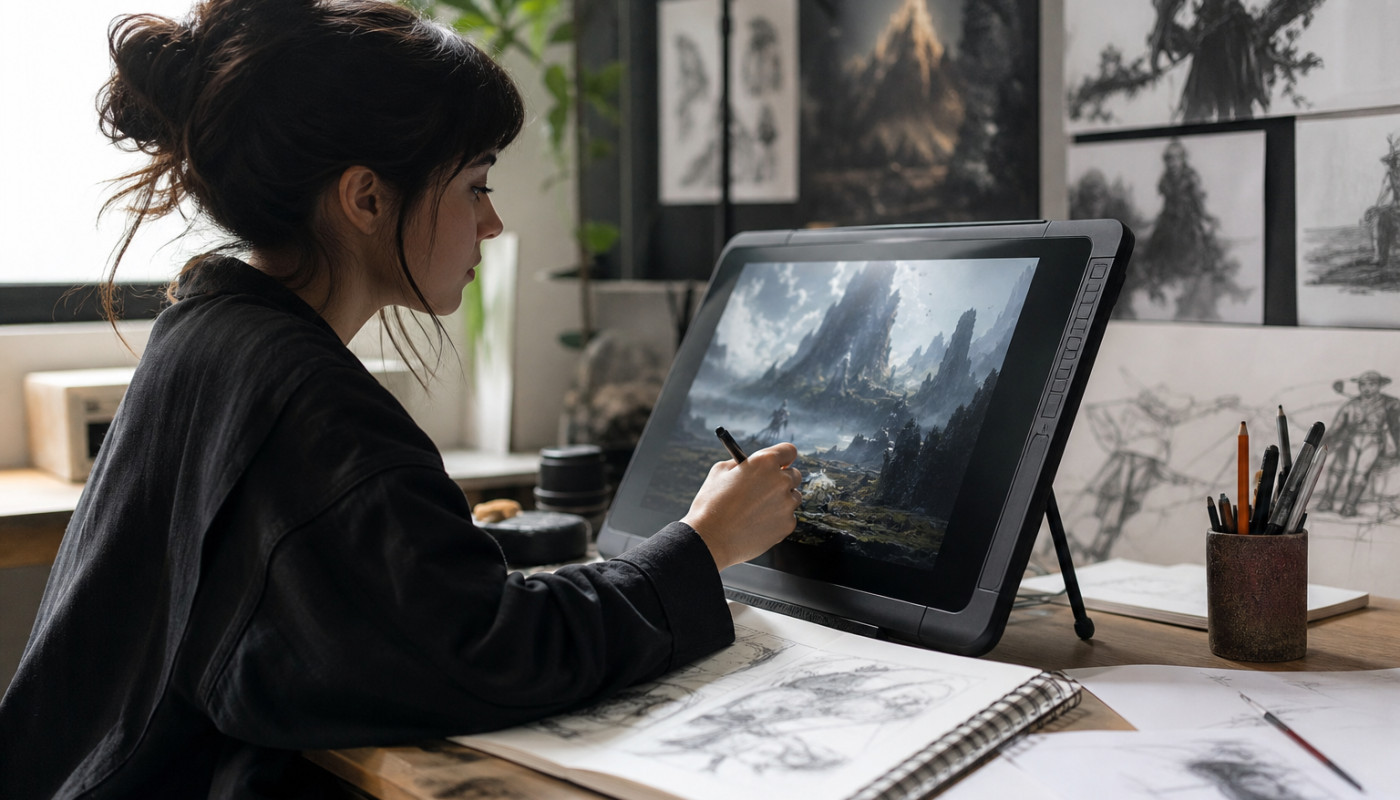
Pencils still matter, but the decisive moment in image-making is increasingly happening after the sketch, inside software, and often with the help of artificial intelligence. In studios and bedrooms alike, creators are mixing hand-drawn lines with diffusion models, turning rough drafts into polished visuals in minutes, and accelerating workflows that used to take days. The shift is not just aesthetic, it is economic, as AI tools reshape budgets, timelines, and even who gets to call themselves an artist, while raising new questions about ownership and trust.
From rough lines to finished images, fast
One clean sketch, one prompt, and suddenly a dozen variations appear. That is the everyday reality for a growing share of illustrators, concept artists, and designers who now treat AI not as a gimmick, but as a second pair of hands. The technology has matured quickly since the public release of systems such as DALL-E 2, Midjourney, and Stable Diffusion, and the change is measurable: Stable Diffusion reached 10 million users in roughly six weeks after launch in 2022, one of the fastest adoption curves recorded for a consumer creative tool, and it did so without the distribution muscle of a traditional social platform.
Under the hood, diffusion models work by learning statistical patterns from massive datasets and then generating images by iteratively denoising random noise into coherent forms. For artists, the practical consequence is speed and controllability, especially when sketches, depth maps, pose references, or “image-to-image” guidance are added. A rough character silhouette can become a fully rendered figure with consistent lighting, multiple costume options, and background ideas, and then be iterated again with minor changes, which compresses what used to be a long cycle of thumbnails, color keys, and polish passes.
This acceleration is showing up in production pipelines. In game development and animation pre-production, AI-assisted ideation is used to explore environments and props quickly, and then human artists refine, correct, and unify style. In advertising, the tools are used to generate mood boards and story concepts at a pace that matches tight campaign deadlines. The workflow is not always linear, and it is rarely “prompt only”: creators often combine a hand sketch with control methods, such as edge detection and segmentation, to keep composition intact, and they rely on post-processing in Photoshop, Procreate, Blender, or After Effects to regain precision.
The headline promise is “minutes, not days”, but the more honest metric is “iterations per hour”. AI does not eliminate taste, it multiplies decisions. The bottleneck shifts from rendering to selection, art direction, and consistency, and in professional contexts the ability to curate becomes as valuable as the ability to draw. That is why the most productive users are not necessarily those who generate the most images, but those who can steer the model, diagnose failures, and then intervene manually, adjusting anatomy, fixing hands, and aligning outputs to a brand’s visual system.
The new creative economy, with new winners
So who benefits when images become cheaper to draft? Freelancers feel the pressure first, because clients compare timelines and quotes, even when they do not fully understand the process. The macro trend is clear: globally, the cultural and creative sectors employ tens of millions of people, and the market for digital creative software has been expanding for years; into that ecosystem, generative AI arrives as a productivity layer that can redistribute work, rather than simply add a new tool. McKinsey estimated in 2023 that generative AI could add between $2.6 trillion and $4.4 trillion annually across industries, largely through productivity gains, and marketing and sales, software engineering, and customer operations were among the biggest areas of impact.
In practice, AI can lower the barrier to entry for small teams. A solo creator can now produce concept art, mock packaging, or social visuals without hiring a full roster, and that changes the calculus for startups, local brands, and indie publishers. At the same time, established studios can use AI to accelerate early stages and allocate senior artists to high-impact tasks, like style definition and final compositing. The winners are often those who combine domain knowledge with an AI-assisted workflow, because the model can generate options, but it cannot reliably satisfy nuanced constraints, such as “make this character recognizable across 40 shots, in the same costume, at different camera angles”, unless the human builds a disciplined pipeline.
There is also a new market for “micro-commissioning”. Instead of commissioning one polished illustration, clients ask for sets of variations, multiple aspect ratios, and rapid experimentation. That can reward artists who can package their services as art direction plus AI execution, with clear deliverables and predictable revision cycles. Yet it can undercut artists whose value proposition is primarily speed of rendering, because AI compresses that advantage. The economic shift is not hypothetical; Adobe’s own reporting underscores how quickly AI features can scale. Its generative AI model Firefly, introduced in 2023, helped drive the creation of billions of assets within months, a signal that mainstream creative suites are building generative features into default workflows rather than treating them as optional extras.
Meanwhile, platforms and communities are reorganizing around AI-native creativity. Prompt marketplaces, model-sharing hubs, and custom fine-tunes create new ways to monetize style, workflows, and know-how. For some, the business is no longer “I will draw your poster”, but “I will design a repeatable system that outputs on-brand visuals”. For others, the opportunity is education: teaching teams how to adopt these tools without losing control over quality, legal risk, and identity. If you want a broader view of how European digital ecosystems and innovation policies intersect with these shifts, click here to find out more.
Copyright, consent, and the training-data fight
The images may be new, but the disputes are very old: who owns the work, who gets paid, and who gets to decide. Generative AI drags those questions into courtrooms and policy debates because the models are trained on vast corpora of images, some licensed, many scraped from the open web, and often without explicit consent from individual creators. In the United States, the Copyright Office has clarified in guidance that works created by a machine without human authorship are not eligible for copyright protection, while human-authored contributions can be protected, which pushes creators to document their own role in the process. That position shapes how publishers, studios, and marketplaces assess risk, and it also affects whether clients can confidently buy exclusive rights.
On the legal front, Getty Images sued Stability AI in early 2023, alleging copyright infringement related to training and output, and similar litigation has been filed by groups of artists and authors against AI companies, raising questions about fair use and dataset provenance. These cases are still moving through the courts, but they have already influenced corporate behavior: some companies now emphasize licensed training data and offer indemnification in enterprise contracts, while others provide opt-out mechanisms for creators, with varying degrees of transparency. The legal uncertainty is not an abstract concern for working artists, because it affects whether a client will accept AI-assisted deliverables, whether a publisher will commission AI-involved covers, and whether a brand can defend its campaign if challenged.
Europe is also drawing lines. The EU’s AI Act, adopted in 2024, introduces obligations for certain AI systems, and for general-purpose AI models it includes transparency requirements, including providing summaries of training data content, a provision designed in part to address the opacity that fuels creator backlash. Alongside this, copyright frameworks in the EU already contain text-and-data-mining exceptions, with opt-out possibilities for rights holders, adding another layer of complexity. The direction of travel is toward more disclosure and more accountability, but the day-to-day reality for creators remains messy: different jurisdictions, different platform rules, and limited visibility into what any given model actually learned from.
Consent is also an ethical issue, not only a legal one. Many artists object to their styles being mimicked at scale, especially when prompts explicitly request “in the style of” living creators. Some platforms have restricted those prompts; others have not. The result is a cultural friction that is reshaping norms inside creative communities, where AI use can be celebrated as innovation or criticized as appropriation, sometimes within the same group. For newsroom-style illustration and editorial art, the stakes include credibility, because audiences may care not only about the image’s quality, but about how it was made.
Authenticity and trust: the next battleground
If AI can generate anything, what do we believe? That question is now central to visual culture, from memes to marketing, because the same tools that help artists create can also be used to deceive. Deepfakes and synthetic imagery complicate the evidentiary value of photos, while brand-safe “generative” campaigns can still provoke backlash if audiences feel misled. Trust is becoming a feature, not a byproduct, and that is why provenance tools, watermarking, and content credentials are being pushed by both regulators and industry coalitions.
Adobe, for example, has advanced “Content Credentials” through the Content Authenticity Initiative, aiming to attach metadata about how an image was made, including whether generative AI was involved. On the technical side, watermarking approaches range from visible marks to imperceptible signals embedded in pixels, though robustness remains a challenge, because cropping, compression, and re-rendering can strip signals away. Meanwhile, social platforms and news organizations are developing policies about labeling synthetic media, but enforcement is uneven, and the incentives are complicated, because synthetic imagery can drive engagement.
For creators, authenticity is also about voice. When models converge on popular aesthetics, it becomes easier to produce competent images that look like everything else, and that can flatten visual diversity. The countertrend is that artists are using AI to push into stranger, more personal territories, training custom models on their own work, or using AI as a disruption tool to break habits and then reassert control with hand edits. The most compelling AI-assisted art often has a clear human signature: a distinct composition sense, intentional constraints, and a willingness to reject “good enough” outputs.
In professional settings, trust is increasingly operationalized. Teams write internal rules: what tools are allowed, what data can be uploaded, how to handle client confidentiality, and when to disclose AI involvement. They also budget time for verification, because AI images can contain subtle factual errors, from impossible architecture to misrepresented products. The creative director’s job becomes part editor, part risk manager, and the artist’s job becomes part craftsperson, part systems thinker. The result is not the end of drawing, but a redefinition of where skill sits, and the redefinition is happening faster than institutions can update curricula, contracts, and norms.
Planning your next project, realistically
Set the budget around outcomes, not hype, and book time for art direction, revisions, and legal checks. Ask vendors whether training data is licensed, and whether AI use will be disclosed. If you need consistency across assets, reserve extra iterations. In some regions, grants for digital innovation can help, so check local cultural funds before commissioning.
Similar articles

Exploring The Benefits Of Using AI-powered Chatbots For Customer Service

Exploring The Role Of AI In Revolutionizing Visual Content Creation
How Automated Tools Streamline Kubernetes Cluster Upgrades And Maintenance

Techniques To Resist The Urge To Contact An Ex Using Modern Apps

Exploring The Future Of Automated Chatbot Development And Multi-Channel Integration

How To Streamline Your IT Helpdesk With A Compliance-focused Chatbot
